


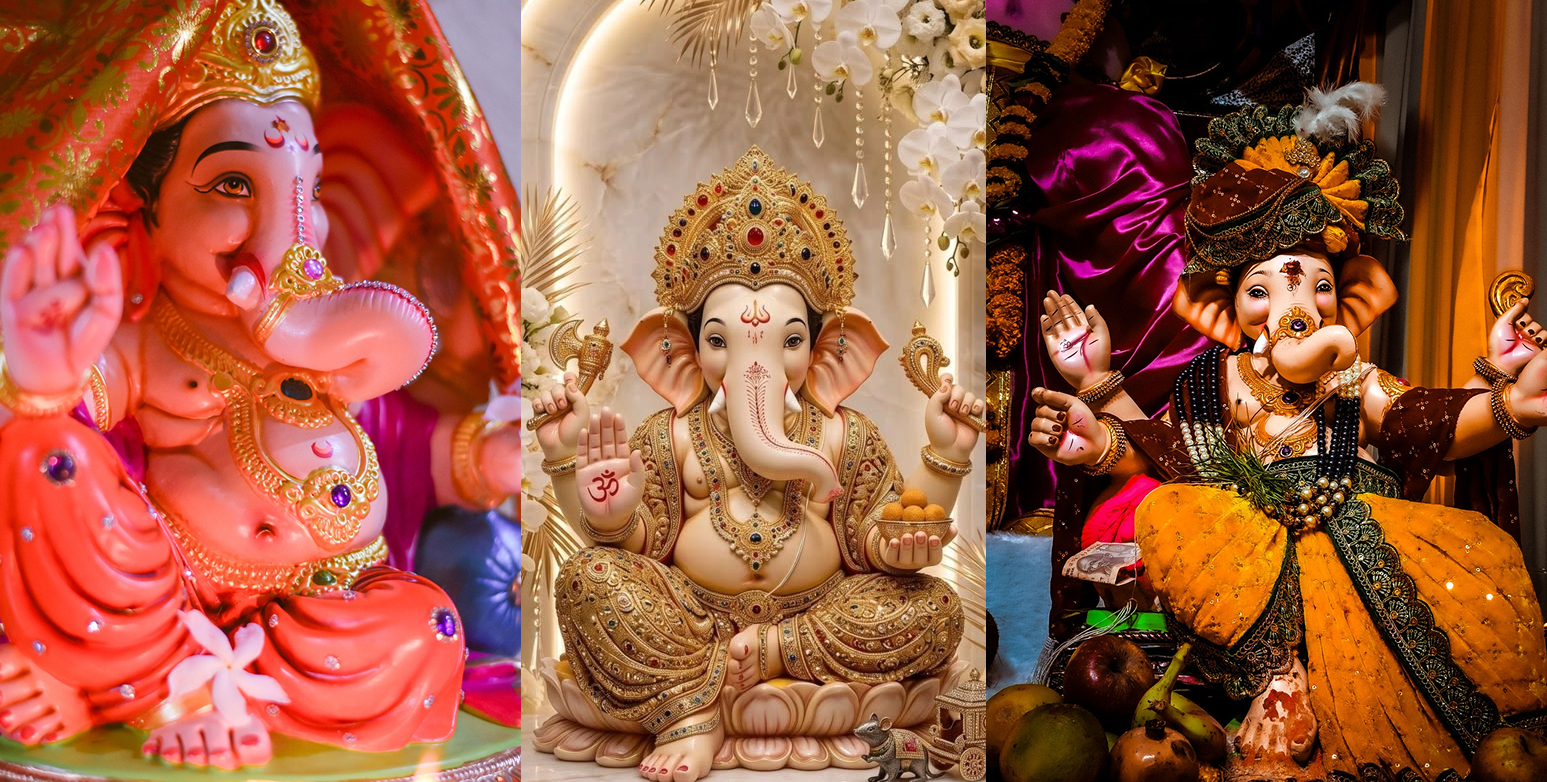




WHAT MAKES CHOVOTH IN GOA SPECIAL?
1. A FESTIVAL OF HOMECOMING
For many Goan families, Chavath is one of the most anticipated times of the year.Goans living elsewhere return to their ancestral villages. Siblings and cousins reunite. Grandparents, parents and children gather, together as one big family. Homes that may be quiet for much of the year come alive with familial conversations, community cooking, collective prayers and celebration. And the family Ganesh idol becomes the centre of this reunion.
In many homes, preparations begin well before Chaturthi — cleaning and decorating the house, preparing traditional recipes, gathering the natural bounty required for the Matoli and creating the Dekhava, an elaborate festive display.
2. THE MATOLI — A CANOPY OF GOA’S MONSOON BOUNTY
One of the most distinctive sights of a Goan Chavath is the Matoli, which is a traditional canopy created above the Ganesh shrine and decorated with an extraordinary display of seasonal fruits, vegetables, flowers, leaves, branches and forest produce.
Look closely and the Matoli becomes a celebration of Goa’s natural abundance.It reflects the close relationship between Goan homes, agriculture, forests and the monsoon landscape — bringing nature into the heart of the household.
3. A FEAST FOR THE SENSES
Chavath brings some of Goa’s most distinctive home-cooked vegetarian food to the table.
Festive preparations vary between communities and families, but you may encounter:
Fried Modak — a festive sweet made with coconut, jaggery and cardamom.
Panchkhaji — a selection of traditional fried sweets prepared during the festive season.
Khatkhatem — a mixed vegetable preparation made with seasonal produce and coconut.
Moong Gaathi — a preparation of green gram associated with festive meals.
AmbadyacheSasav — a sweet, sour and mildly spicy preparation of hog plums with mustard and coconut.
Payas — a traditional rice-and-milk dessert.
These are accompanied by seasonal vegetable preparations, bhajis, nevri, laddoos and other homemade festive delicacies.
THE BEST WAY TO EXPERIENCE CHOVOTH FOOD
The most memorable Chavath meal is often not found on a restaurant menu.It is found in a Goan home.If you are fortunate enough to be invited into a family home, accept the invitation respectfully and experience the meal as a guest — sharing in a tradition rather than simply observing it.
4. THE SOUND OF CHOVOTH
Chavath has its own distinctive soundscape.Devotional bhajans fill many homes and community spaces, while the rhythm of the Ghumat, a traditional Goan percussion instrument, adds a distinctive pulse to celebrations.For those interested in music and living heritage, Chovoth offers a different way of experiencing Goa — through sound as much as sight.
5. LOOK BEYOND THE GANESH IDOL
The Ganesh idol is naturally the centrepiece of Chavath, but the wider cultural experience is just as fascinating.
Across Goa, families and communities create elaborate Dekhavas — festive displays and tableaux that bring together mythology, history, folklore, contemporary themes, art, craftsmanship and storytelling.Some are intimate household creations. Others become large community installations involving considerable imagination and collective effort.
The Directorate of Art & Culture also organises state-level Matoli and Dekhava competitions, helping encourage participation and preserve these distinctive traditions.
Traveller’s tip
Explore villages in the evening and look for community displays. Some of the most interesting expressions of Chavath can be found away from the largest public installations.
6. CUMBHARJUA — WHERE CHOVOTH TAKES TO THE WATER
One of Goa’s most unusual chavath traditions unfolds in Cumbharjua.On the seventh day of the festival, the village hosts the spectacular Sangod Utsav, where traditional canoes are joined together to create floating platforms carrying elaborate tableaux.
These floating stages travel along the Cumbharjua canal, with scenes inspired by mythology, folklore and contemporary themes. Traditional music and performances accompany the celebration, creating a remarkable community spectacle on the water.
WHY IT IS SPECIAL
Imagine a lush Goan canal filled with traditional canoes transformed into floating stages.Mythological scenes come alive. Music travels across the water. Villagers gather along the banks. And the Ganesh immersion becomes part of a distinctive community performance.
This is Goa’s floating theatre.
THE STORY BEHIND SANGOD
The CumbharjuaSangod tradition is associated with the history of the local deity and the movement of the ShantadurgaCumbharjuvekarin temple.
The tradition evolved around carrying the Ganesh idol on a Sangod — a platform created by joining two canoes — before immersion.Over time, this ritual developed into an elaborate community celebration. Younger generations continue to participate in designing sets, costumes and performances and in navigating the floating platforms.It is a powerful example of living heritage — a tradition that continues to evolve while remaining rooted in community.
7. ADPAI — WHERE FAMILY IS THE FESTIVAL
In Ponda taluka, the village of Adpai offers another fascinating expression of Chavath.
The village is known for a large community celebration in which extended families come together under one umbrella.Large family groups participate in the festivities, with collective celebrations and an elaborate immersion procession featuring colourful tableaux.
What makes Adpai particularly interesting is the way it demonstrates that Chavath is not simply about the deity or the spectacle.
It is about:Family. Community. Ancestral homes. Shared responsibility. Collective celebration.
8. MAYEM — DISCOVER THE HANDS BEHIND THE IDOL
Before a Ganesh idol arrives in a Goan home, it begins with the hands of an artisan.In Mayem, the Kumbharwado locality is traditionally associated with families who make Ganesh idols from terracotta. The craft has been passed down through generations, with idols finding their way to different parts of Goa during Chavath.
For travellers interested in craft and heritage, this offers another way to experience the festival:Before you see the idol in a Goan home, discover the hands that created it.
Marcel and St. Estevam are also associated with distinctive Ganesh idols and community celebrations, including large and creative Ganapati images made using different materials.
9. CHOVOTH AND GOA’S MONSOON LANDSCAPE
There is something particularly evocative about experiencing Chavath in Goa during the monsoon.
The landscape is at its greenest.Rice fields shimmer across the countryside. Rivers and canals are full. Forests are lush. Village ponds and wells become part of the landscape. The air carries the freshness of rain.
And the abundance of the season finds its way into both the Matoli and the festive kitchen.
Chavath is therefore more than a festival on Goa’s calendar.It is a festival deeply connected to the seasonal rhythm of Goa.
10. CHOVOTH AS LIVING HERITAGE
For travellers seeking meaningful cultural experiences, Chavath offers an important distinction.This is not a festival created for tourists. It is a festival that belongs to Goans.
Visitors are guests in this celebration.That makes the experience especially meaningful — but it also calls for sensitivity and respect.
The most rewarding way to experience Chavath is not to stand outside it looking in, but to understand the traditions, people and stories that give the festival its meaning.
11. HOW TO EXPERIENCE CHAVATH AS A TRAVELLER
DO
Dress respectfully, particularly when visiting homes, temples and religious spaces.
Ask before photographing people, rituals or private ceremonies.
Accept food graciously if invited into a home.
Explore villages, not just large public celebrations.
Support local artisans and small businesses.
Try traditional Goan festive food.
Learn about local customs before participating.
Choose eco-friendly celebrations and follow local guidance on immersion.
DON’T
Enter a private home or shrine without invitation.
Photograph people during intimate rituals without permission.
Treat religious ceremonies simply as entertainment.
Obstruct processions for photographs.
Touch idols, offerings or decorations unless invited.
Assume every Chavath celebration follows the same schedule.
12. A FESTIVAL THAT SUPPORTS LOCAL LIVELIHOODS
Chavath also creates an important seasonal ecosystem of local livelihoods.
The festival supports idol makers, artisans, florists, farmers, fruit and vegetable growers, sweet makers, decorators, musicians, transport providers, retailers and local entrepreneurs.
In this way, the festival demonstrates how culture, community and local economic activity come together.
Goa also has several initiatives such as the Goa Chavath e-Bazaar, bringing local women entrepreneurs and self-help groups into the festive economy through an online marketplace.
13. CELEBRATING RESPONSIBLY
The beauty of Chavath is inseparable from the beauty of Goa’s natural landscape.
As environmental awareness grows, many celebrations are embracing natural and eco-friendly materials for idols and decorations.
Visitors can contribute by supporting responsible celebrations and following local guidance on immersion.
Celebrate the festival. Protect the landscape that makes Goa special.
14. HOW LONG SHOULD YOU STAY?
2–3 DAYS
Experience the core festival atmosphere, food, village celebrations and festive displays.
4–5 DAYS
Combine Chavath with Goa’s villages, temples, heritage, cuisine and monsoon landscapes.
7+ DAYS
Explore later community celebrations, including traditions such as Sangod in Cumbharjua, subject to the year’s local programme.
Because different families and communities follow different schedules, check local announcements before planning around a specific procession or celebration.
15. A SUGGESTED CHAVATH JOURNEY
DAY 1 — ENTER FESTIVE GOA
Explore:
Ponda • Marcel • Mayem
Discover:
Temple traditions • Ganesh idol-making • Village landscapes • Matoli traditions • Festive food
DAY 2 — EXPERIENCE CHOVOTH
Spend time exploring a Goan village.
See:
Ganesh installations • Matoli decorations • Community displays • Festive food • Bhajans and music
Where appropriate and with permission, experience the warmth of a traditional Goan household celebration.
DAY 3 — GO BEYOND THE FESTIVAL
Explore Goa’s hinterland, heritage villages, spice plantations, rivers, waterways and local cuisine.
DAY 7 — CUMBHARJUA SANGOD
If your visit coincides with the seventh-day celebration, experience one of Goa’s most distinctive cultural traditions.
Watch decorated canoes transform into floating stages as mythology, folklore and community creativity come alive along the Cumbharjua canal.
16. THE GOAN CHOVOTH GLOSSARY
Chovoth / Chavath — The Goan names commonly used for Ganesh Chaturthi.
Matoli — A natural canopy or decorative arrangement of seasonal produce, leaves, flowers and forest bounty above the Ganesh shrine.
Murti — The sacred image or idol of Lord Ganesha.
Uttar Puja — The concluding worship performed before the idol is taken for immersion.
Visarjan — The immersion of the Ganesh idol in a water body.
Sangod — A traditional floating platform created by joining two canoes, central to the distinctive Cumbharjua celebration.
Dekhava — Festive displays and tableaux created around the festival.
Ghumat — A traditional Goan percussion instrument used in devotional and cultural performances.
17. TAKE HOME A PIECE OF GOA
Instead of another generic beach souvenir, look for something made by a Goan artisan.
Consider taking home:
Traditional Goan crafts
Locally made food products
Goan design and artwork
Handmade décor
Locally produced festive products
Take home a piece of Goa’s creativity — not just a photograph.
18. WHY EXPERIENCE CHOVOTH IN GOA?
Ganesh Chaturthi is celebrated across India in many spectacular ways.
But Goa offers something particularly intimate.
Here, the festival takes you:
Inside ancestral homes. Into village communities. Under a Matoli of monsoon bounty. Around a Goan festive table. To the rhythm of the Ghumat. Along a canal carrying a floating theatre. Into crafts and traditions passed from one generation to another.
And ultimately, into a Goa that exists beyond the beach.
Come for Chavath. Stay for the stories. Leave with a deeper understanding of Goa.
Chavathichi Shubhechha!


